Mulank vs Bhagyank: What is the Difference and Which One Should You Focus On?
You have probably heard both words – Mulank and Bhagyank – used together in conversations about Vedic numerology. Most people assume they mean the same thing, or that one is just a more detailed version of the other. But they are actually two separate numbers with two completely different purposes.
This guide explains what each number means, how to calculate both step by step, and – most importantly – which one you should look at depending on what you want to understand about yourself.
What is Mulank?
Mulank (मूलांक) is also called the Birth Number or Root Number. The word comes from Sanskrit: “Mool” means root, and “Ank” means number. It is exactly what the name says – your root number, the foundation of your numerological profile.
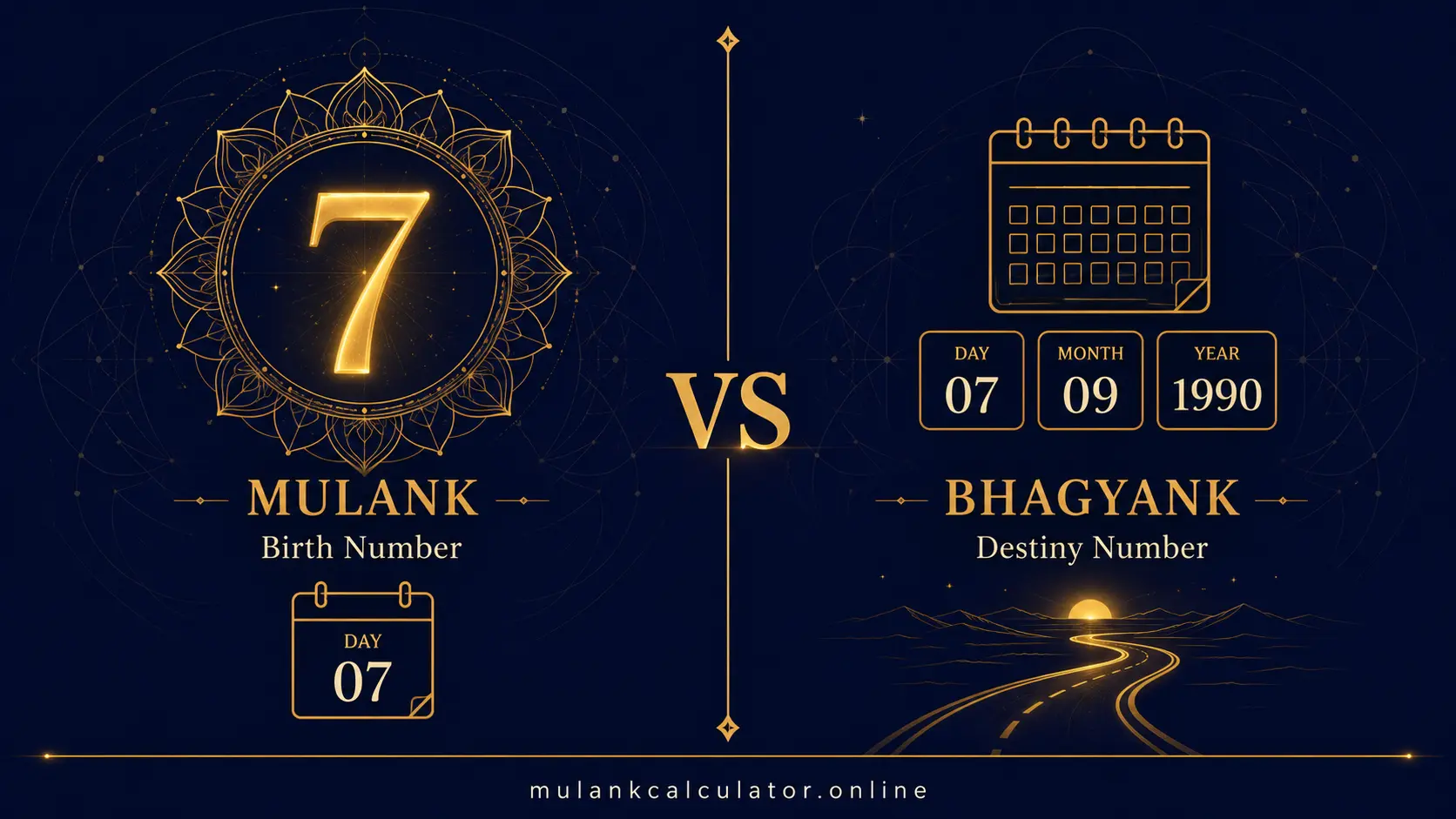
Mulank is calculated using only the day you were born. You do not need the month or the year. Just the date.
If you were born on the 7th, your Mulank is 7. If you were born on the 23rd, you add 2 + 3 = 5, so your Mulank is 5. If the result is still two digits, you keep adding until you reach a single digit between 1 and 9.
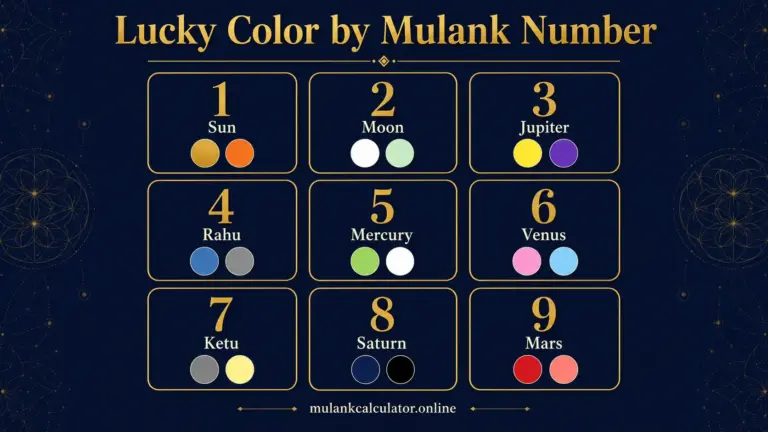
In Vedic numerology, each Mulank from 1 to 9 is ruled by one of the nine planets – Navagraha. For example, Mulank 1 is ruled by the Sun, Mulank 2 by the Moon, Mulank 3 by Jupiter, and so on up to Mulank 9 which is ruled by Mars.
Your Mulank is believed to reflect your core personality – how you think, how you react instinctively, what your natural strengths are, and how you approach day-to-day life before you have had time to think about it.
Want to find your Mulank right now? Use the free Mulank Calculator– just enter your date of birth and your result appears instantly.
What is Bhagyank?
Bhagyank (भाग्यांक) is also called the Destiny Number or Fortune Number. The word comes from “Bhagya” (meaning fate or fortune) and “Ank” (meaning number).
Bhagyank is calculated using your complete date of birth – day, month, and year together. This is the key difference from Mulank, which only uses the day.
To find your Bhagyank, you add all the digits of your full date of birth and reduce the total to a single digit. If your date of birth is 15 August 1995 (15-08-1995), you add 1+5+0+8+1+9+9+5 = 38, then 3+8 = 11, then 1+1 = 2. Your Bhagyank is 2.
Where Mulank reflects your personality and inner nature, Bhagyank is believed to reflect your life path – the direction life tends to pull you toward, the lessons that repeat across your lifetime, and the larger purpose you are here to fulfill. It is less about who you are in the moment and more about where you are headed over decades.
How to Calculate Both – Step by Step
Calculating Mulank
- Write down only the day of your birth (ignore month and year)
- If it is a single digit (1 to 9), that is your Mulank
- If it is two digits, add both digits together
- If the result is still two digits, add again until you reach one digit
Example: Born on the 29th – 2 + 9 = 11 – 1 + 1 = 2. Mulank is 2.
Calculating Bhagyank
- Write your full date of birth (day + month + year)
- Add every single digit together
- Reduce the total to a single digit by adding again if needed
Example: Born on 29 March 1998 (29-03-1998) – 2+9+0+3+1+9+9+8 = 41 – 4+1 = 5. Bhagyank is 5.
Notice that the same person has Mulank 2 and Bhagyank 5. Two completely different numbers from the same birth date – because they use different parts of that date to calculate different things.
The Core Difference – One Clear Table
| Mulank (मूलांक) | Bhagyank (भाग्यांक) | |
|---|---|---|
| Also called | Birth Number, Root Number | Destiny Number, Fortune Number |
| Calculated from | Day of birth only | Full date of birth (day + month + year) |
| What it reveals | Core personality and natural instincts | Life path, destiny, and long-term direction |
| Changes over life | Never | Never |
| Ruling system | Navagraha planetary system | Same |
| Best used for | Understanding who you are | Understanding where life is leading you |
The simplest one-line summary: Mulank shows who you are. Bhagyank shows where life is taking you.
Can Mulank and Bhagyank Be the Same Number?
Yes, and it happens quite often. Someone born on the 1st of January 2000 (01-01-2000) would have Mulank 1 (from the day) and Bhagyank 0+1+0+1+2+0+0+0 = 4. Different numbers in this case.
But someone born on the 5th of May 1994 (05-05-1994) would have Mulank 5 and Bhagyank 0+5+0+5+1+9+9+4 = 33 – 3+3 = 6. Also different.
When Mulank and Bhagyank happen to be the same number, Vedic numerology considers this a sign of strong alignment – your inner personality and your life direction are moving in the same direction naturally, which can make life feel more fluid and less like a constant push and pull.
When they are different – which is more common – it is not a problem at all. It simply means your natural personality (Mulank) and your life’s larger direction (Bhagyank) come from different energies. Many people experience this as a sense of inner complexity or feeling pulled in two directions at certain points in life. Understanding both numbers helps make sense of that feeling.
Mulank vs Bhagyank – Which One is More Important?
This is the question most people actually want answered, and the honest answer is: it depends on what you are trying to understand.
Use Mulank when you want to understand:
- Your core personality traits and natural behaviour
- How you instinctively respond to people and situations
- What kind of work environment suits you naturally
- Your day-to-day strengths and the tendencies to watch out for
- Compatibility with other people in relationships and partnerships
Use Bhagyank when you want to understand:
- The overall direction your life tends to move toward
- Long-term career paths that may bring deeper fulfillment
- The karmic patterns or repeating lessons in your life
- Why certain themes or challenges keep appearing across different phases
- Your broader life purpose from a Vedic numerology perspective
Use both together when you want a complete picture. Most experienced numerologists look at Mulank, Bhagyank, and a third number called Namank (Name Number, calculated from the letters in your full name) together. Mulank tells you the starting point. Bhagyank tells you the direction. Namank tells you how the world experiences you from the outside.
For most people who are new to Vedic numerology, starting with Mulank is the best entry point – it is simpler to calculate, easier to connect with personally, and gives you immediate, relatable insight into your own nature. Bhagyank adds depth once you have understood your root number.
Mulank aur Bhagyank mein kya antar hai?
Seedha jawaab: Mulank sirf aapki janam tariikh (date) se nikala jaata hai, jabki Bhagyank poori janam tariikh (date + month + year) se.
Mulank aapka swabhav aur aapki basic personality batata hai – aap kaise sochte hain, kaise react karte hain, aur aapki natural strengths kya hain. Bhagyank aapke jeevan ki disha batata hai – aap kahan ja rahe hain, kaunse karmic lessons aapke liye hain, aur aapka life purpose kya hai.
Dono milkar aapka poora numerological profile banate hain.
Practical Example – Same Person, Both Numbers
Let’s take a real example to see how differently the two numbers can work.
Say someone is born on 17 June 1992 (17-06-1992).
Mulank calculation: Only the day – 17 – 1+7 = 8. Mulank is 8, ruled by Saturn.
This person, according to Mulank 8, is likely ambitious, resilient, practical, serious about responsibility, and someone who works steadily toward long-term goals. They may come across as reserved but are deeply reliable.
Bhagyank calculation: Full date – 1+7+0+6+1+9+9+2 = 35 – 3+5 = 8. Bhagyank is also 8 in this case.
When Mulank and Bhagyank are the same – as they are here – it suggests a strong natural alignment between how this person operates day to day and the direction their life tends to pull them. A Saturn-8 energy runs through both their personality and their destiny, meaning themes of discipline, karma, and long-term achievement likely show up consistently across their life.
Now imagine the same birth date but a different year – 17 June 1990 (17-06-1990).
Mulank: Still 8 (same day, same number).
Bhagyank: 1+7+0+6+1+9+9+0 = 33 – 3+3 = 6. Now Bhagyank is 6, ruled by Venus.
Same core personality (Saturn-8, driven and resilient) but a life path governed by Venus-6 energy – care, harmony, relationships, beauty. This person may find that life repeatedly brings them into situations involving family, partnership, creative work, or community care, even if their natural personality style is more disciplined and independent. That is the Mulank-Bhagyank difference in action.
FAQs
Is Mulank the same as Bhagyank?
No. Mulank uses only your day of birth and reflects your personality. Bhagyank uses your full date of birth and reflects your life path. They are related but answer different questions entirely.
What if my Mulank and Bhagyank are the same number?
It is considered a positive alignment in Vedic numerology. Your personality and life direction are working together naturally, which can make it easier to pursue goals that feel authentic. It does not mean life will be without challenges, but the direction of your energy tends to be more unified.
Which is more important – Mulank or Bhagyank – for marriage compatibility?
Most Vedic numerologists check both. Mulank compatibility tells you how two people naturally interact on a daily basis – their communication styles, emotional responses, and general compatibility in day-to-day life. Bhagyank compatibility gives a broader view of whether two people’s long-term directions are aligned. For marriage, both matter and ideally both are checked together.
Can I calculate my Bhagyank the same way as Mulank?
No – the method is different. Mulank reduces only the day to a single digit. Bhagyank adds all digits of the full date (day + month + year) and reduces the total. Using the Mulank method on a full birth date gives you the wrong number.
Does Mulank change over time?
No. Since it is based on your fixed date of birth, it stays the same throughout your life. What can change is how clearly you express its energy, which often develops more fully as you grow older and more self-aware.
What is Namank and how is it different from both?
Namank (Name Number) is a third core number in Vedic numerology, calculated from the letters in your full name using a letter-to-number system. Where Mulank reflects your inner self and Bhagyank reflects your life path, Namank reflects how the world perceives you – your outer expression and the energy you project socially and professionally.
Summary
- Mulank = day of birth only = your core personality and natural instincts
- Bhagyank = full date of birth = your life path and long-term direction
- Both numbers are derived from the same birth date but use different parts of it
- Neither is more important than the other – they answer different questions
- Most people start with Mulank because it is simpler and more immediately personal
- For a complete numerology profile, look at Mulank, Bhagyank, and Namank together
If you have not calculated your Mulank yet, start there. Use the free Moolank Calculator – enter your date of birth, get your birth number instantly, and download a detailed PDF report covering your ruling planet, personality traits, strengths, lucky color, lucky day, and compatible numbers. No sign-up required.