How to Calculate Mulank by Date of Birth: A Simple Step-by-Step Guide
Your birth date hides a single number that Indian numerology treats as a window into who you are. It is called your Mulank, and here is the good news: you do not need a numerologist or any fancy math to find it. If you can add small numbers in your head, you can work yours out before your chai goes cold.
Numbers run deep in Indian life. A 2021 Pew Research study found that 44% of Indians believe in astrology, and a striking 83% still pick auspicious dates before weddings, house-warmings, and business launches. Your Mulank sits right at the centre of that number-driven thinking, so it is worth knowing yours.
Let us cut to the chase and figure it out.
What is Mulank?
Mulank (also spelled Moolank or Mool Ank, and written as मूलांक in Hindi) means “root number.” It is pulled from just one part of your date of birth: the day you were born. Not the month. Not the year. Only the date of the month.
That single detail trips up a lot of people, so let me say it plainly. To find your Mulank, you look at the day you were born and nothing else. Someone born on the 7th, in any month, in any year, has a Mulank of 7. Born on the 18th? You will reduce that to a single digit in one quick step, and I will show you how below.
Think of your Mulank as your core wiring. It reflects your natural instincts, how you think, and the way you react before you have had time to overthink anything.
How to Calculate Mulank in 3 Steps
The whole thing boils down to three small steps.
- Take the day of the month you were born. Ignore the month and the year completely.
- If that day is already a single digit (1 to 9), you are done. That is your Mulank.
- If the day has two digits (10 to 31), add the two digits together. Keep adding until you land on a single digit between 1 and 9. That final number is your Mulank.
Quick example: someone born on the 15th does 1 + 5 = 6. Their Mulank is 6. No rocket science involved.
Worked Examples (So It Actually Sticks)
Reading the steps is one thing. Watching them play out is where the penny drops.
Born on the 5th The day is already a single digit, so your Mulank is simply 5. Piece of cake.
Born on the 21st Add the digits: 2 + 1 = 3. Your Mulank is 3.
Born on the 18th Add the digits: 1 + 8 = 9. Your Mulank is 9.
Born on the 29th This one has an extra hop. First, 2 + 9 = 11. Since 11 is still two digits, you reduce again: 1 + 1 = 2. Your Mulank is 2.
Born on the 11th or the 22nd People often ask about these two because Western numerology treats 11 and 22 as special “master numbers.” In classic Mulank, though, you reduce them like any other date. So 11 becomes 1 + 1 = 2, and 22 becomes 2 + 2 = 4. Simple as that.
Notice the pattern? Once the year and month are out of the picture, the calculation is smooth sailing every single time.
Full Chart: Every Birth Date and Its Mulank
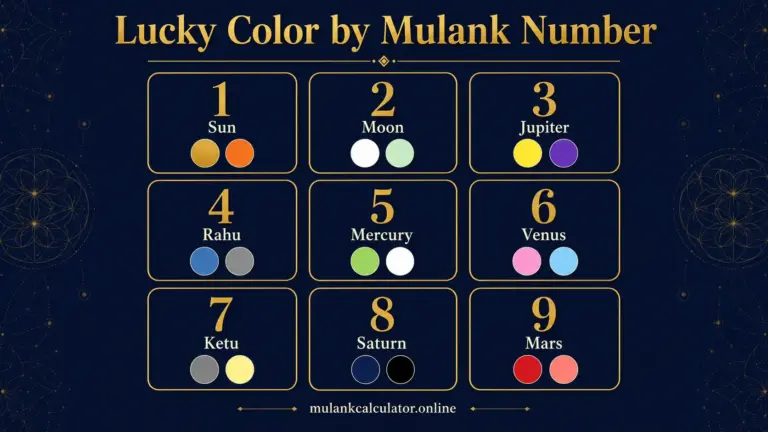
Do not feel like doing the sums? Here is the whole map. Find the day you were born, and read across. I have added the ruling planet for each number too, since that is usually the next thing people want to know.
| Mulank | If you were born on | Ruling planet |
|---|---|---|
| 1 | 1, 10, 19, 28 | Sun |
| 2 | 2, 11, 20, 29 | Moon |
| 3 | 3, 12, 21, 30 | Jupiter |
| 4 | 4, 13, 22, 31 | Rahu |
| 5 | 5, 14, 23 | Mercury |
| 6 | 6, 15, 24 | Venus |
| 7 | 7, 16, 25 | Ketu |
| 8 | 8, 17, 26 | Saturn |
| 9 | 9, 18, 27 | Mars |
Each ruling planet is believed to colour the personality of that number. A Mulank 1 person carries the bold, take-charge energy of the Sun, while a Mulank 2 leans toward the softer, more emotional pull of the Moon. That is a rabbit hole for another day, but the chart above tells you where you stand at a glance.
Mulank vs Bhagyank vs Namank
Here is where beginners often get their wires crossed, so it is worth clearing up.
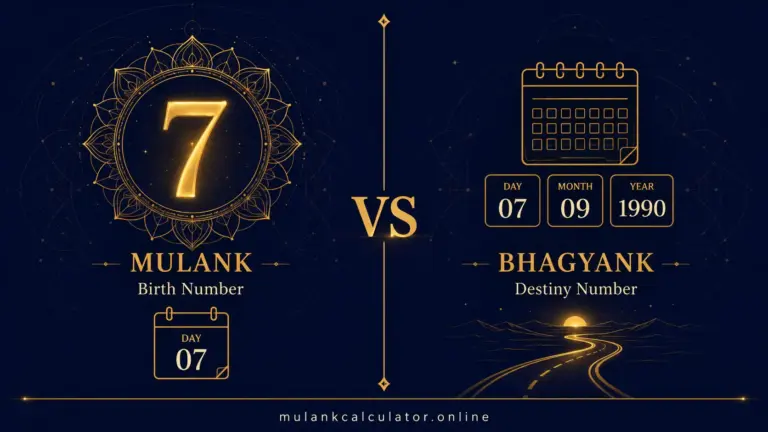
Mulank comes from your birth day only. It describes your inner personality, the version of you that shows up on instinct.
Bhagyank, on the other hand, is your destiny number. It is calculated from your complete date of birth, meaning the day, month, and year are all added together. It speaks to your life path and the bigger direction your journey tends to take. If you want the full breakdown of how these two differ and why both matter, our guide on Mulank and Bhagyank walks through it properly.
Namank is a third number, drawn from the letters of your name rather than your birth date. It shapes how the outside world reads you.
Short version: Mulank is who you are inside, Bhagyank is where life is pulling you, and Namank is how others experience you.
The Most Common Mistake People Make
If you take away one thing from this guide, make it this. The single biggest error is adding the full date of birth when calculating Mulank. You will see this floating around online, and it is simply not how the root number works.
Mulank uses the birth day alone. The moment you start folding in the month and the year, you have quietly switched over to calculating Bhagyank instead. Two different numbers, two different meanings. Mix them up and the whole reading goes sideways.
So keep them in separate boxes in your head, and you will never trip over this again.
What Do You Do With Your Mulank Once You Have It?
Knowing the number is only the starting line. In practice, people use their Mulank to understand their natural strengths, spot the patterns behind their choices, and get a feel for which people and situations they click with. Some pick lucky colours, days, or even mobile numbers that line up with it.
A word of honesty here: numerology is a belief-based tradition, not a hard science. Treat your Mulank as a mirror for self-reflection rather than a crystal ball, and you will get the most out of it without setting your expectations in the wrong place.
FAQs
Is Mulank calculated from the full date of birth?
No. Mulank uses only the day of the month you were born, reduced to a single digit. The full date of birth is used for Bhagyank, your destiny number.
Are 11 and 22 master numbers in Mulank?
In Western numerology, 11 and 22 are sometimes kept as master numbers. In traditional Indian Mulank, you reduce them to a single digit, so 11 becomes 2 and 22 becomes 4.
Is Mulank the same as the Life Path Number?
Not exactly. The Western Life Path Number is built from your entire date of birth, while Mulank comes from the birth day alone. The closest Vedic match to the Life Path Number is actually Bhagyank.
Can two people have the same Mulank?
Absolutely, and it is very common. Anyone born on the same day of the month shares the same Mulank, regardless of the month or year.
Which Mulank is the luckiest?
No single number is universally lucky. Each Mulank carries its own strengths and challenges, and how well things go usually depends on how you lean into your number’s natural energy.
Ready to Check Yours in One Click?
Now you know the method inside out, and doing it by hand takes barely a minute. But if you would rather skip the arithmetic and see your result along with what it means, our free Mulank calculator does it instantly. Pop in your birth date, and you will have your root number, ready and waiting.