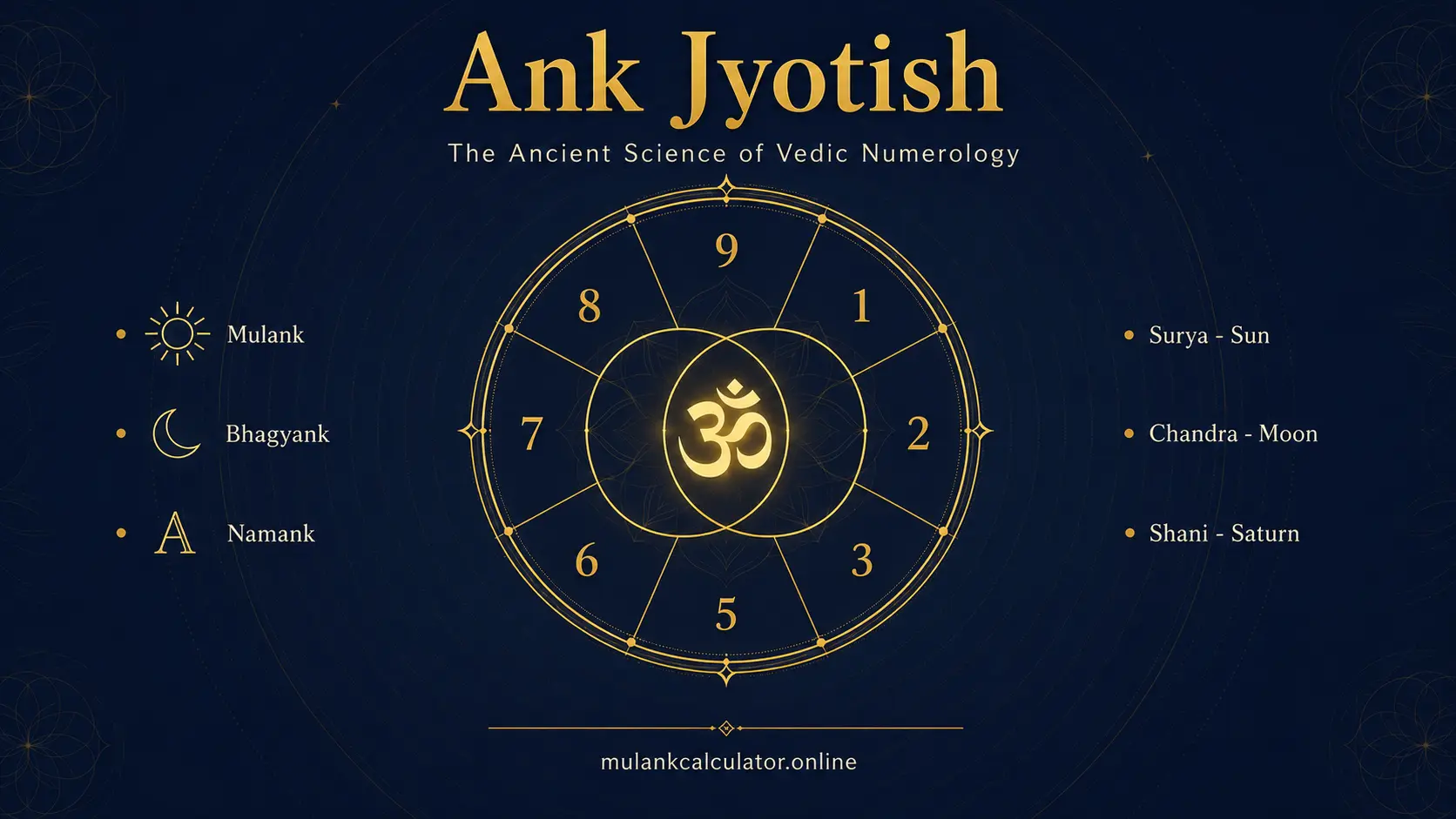
Ank Jyotish Kya Hai? A Complete Guide to Vedic Numerology
If you have heard the words “Ank Jyotish” or “Ank Shastra” and wondered what they actually mean, you are not alone. Most people across India have encountered these terms in family conversations, astrology columns, or while searching for their lucky number or birth number online. But very few have seen a clear, plain-language explanation of what Ank Jyotish is, where it comes from, and how it actually works.
This guide covers everything from the basics – what Ank Jyotish means and how old it is – to the three core numbers at the heart of the system, the nine planets behind every calculation, and how Vedic numerology differs from the Western system most international apps use. No complicated Sanskrit. No jargon. Just a clear explanation you can read in one sitting.
Ank Jyotish Ka Matlab Kya Hai? (What Does Ank Jyotish Mean?)
The word Ank Jyotish (अंक ज्योतिष) comes from two Sanskrit words:
- Ank (अंक) means number
- Jyotish (ज्योतिष) means light, or in this context, astrology – the science of celestial light and its influence on human life
So Ank Jyotish literally translates to “number astrology” – or more loosely, the astrology of numbers. In English, it is most commonly called Vedic numerology.
The name tells you something important about how this system works. In the Indian tradition, Ank Jyotish is not treated as a separate, standalone system. It is understood as a numerical branch of the same Vedic knowledge framework that includes Jyotish Shastra (Vedic astrology), Vastu Shastra (spatial harmony), and Ayurveda. Numbers in this system are not just mathematical quantities – they are expressions of planetary energy, and each number from 1 to 9 carries the vibration of one of the nine Vedic planets (Navagraha).
This is the core idea that makes Vedic numerology different from most other number-based systems in the world.
Ank Jyotish Ki History – Where Did It Come From?
Numerology as a concept is ancient and appears in many cultures – Egyptian, Greek, Chinese, Hebrew, and Indian. But the Indian tradition has a specific and distinctive lineage that sets it apart.
Ancient Vedic roots: The earliest Indian references to numerological thinking appear in Vedic mathematics and the philosophical texts connected to Jyotish Shastra. The Vedic tradition has always assigned cosmic significance to numbers – from the number of syllables in mantras to the nine planets of the Navagraha system, to the 27 Nakshatras (lunar mansions) used in Vedic astrology.
The Chaldean connection: One of the most widely used systems in Indian numerology is the Chaldean system, which originated in ancient Babylon (present-day Iraq) and is considered one of the oldest numerological frameworks in recorded history. Unlike the Western Pythagorean system (which assigns letter values based on alphabetical position), the Chaldean system assigns values based on sound vibrations – which made it naturally compatible with Sanskrit phonetics and Indian naming conventions. This is why Indian numerologists have historically preferred the Chaldean system for name-based calculations.
Everyday Indian life: Over centuries, Ank Jyotish became deeply embedded in Indian cultural practice. Families consult it during Namkaran (naming ceremonies) to choose an auspicious name for a newborn. Businesses check number compatibility before selecting a company name or launch date. People consider numerology alongside their horoscope before major life decisions like marriage, career changes, or home purchases. This is not fringe practice – it is mainstream, everyday Indian life.
Ank Jyotish Mein Kaun Se Numbers Important Hain?
Vedic numerology is built around three core numbers, each derived from different information about a person. Together, these three numbers form a complete numerological profile.
1. Mulank – The Root Number (Birth Number)
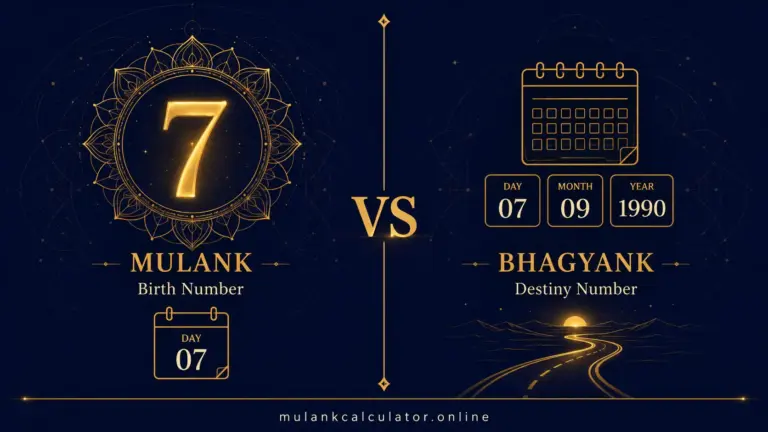
Mulank (मूलांक) is calculated from only the day of your birth – not the month or year, just the date. It reduces to a single digit between 1 and 9, and it is considered the most fundamental of the three numbers.
For example, if you were born on the 23rd, your Mulank is 2+3 = 5. If you were born on the 7th, your Mulank is simply 7.
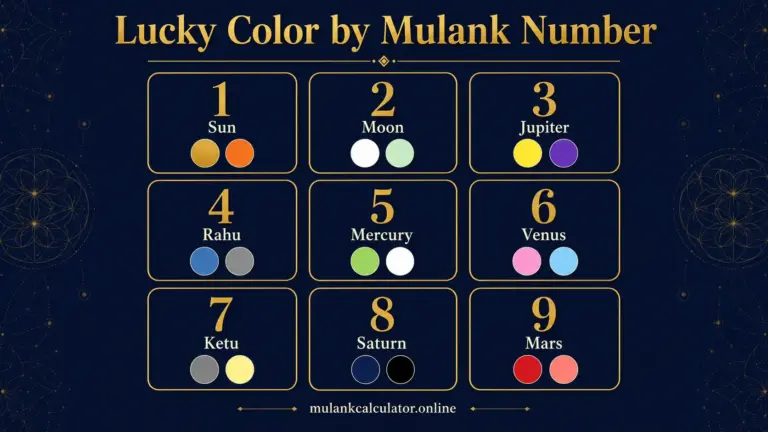
Your Mulank reflects your core personality – the instincts, strengths, and tendencies you were born with. It is the number most directly tied to your natural character and everyday behaviour. Each Mulank from 1 to 9 is ruled by a specific Vedic planet, and that planetary influence shapes everything from your personality type to your lucky color and lucky day.
You can calculate your Mulank instantly and for free at mulank calculator – just enter your date of birth.
2. Bhagyank – The Destiny Number
Bhagyank (भाग्यांक) is calculated from your complete date of birth – day, month, and year all added together and reduced to a single digit. Where Mulank reflects who you are, Bhagyank reflects where life is taking you – your life path, destiny, and the broader karmic direction of your journey.
For example, if your date of birth is 23 August 1995, you add 2+3+0+8+1+9+9+5 = 37, then 3+7 = 10, then 1+0 = 1. Your Bhagyank is 1.
The relationship between Mulank and Bhagyank is one of the most discussed topics in Indian numerology – when they are the same number, your personality and destiny are considered to move in natural alignment. When they differ, each number tells a different part of your story. If you want to understand the full difference between these two numbers, read the detailed guide here: Mulank vs Bhagyank.
3. Namank – The Name Number
Namank (नामांक), also called the Name Number, is calculated from the letters in your full name using a letter-to-number mapping system. It reflects how the world perceives you – your outer expression, your public personality, and the energy you project socially and professionally.
The name you use most frequently (the name people call you daily) is typically used for this calculation. Namank is particularly important in the Indian tradition during Namkaran ceremonies, where parents work with a numerologist or astrologer to choose a name whose Namank aligns harmoniously with the child’s Mulank and Bhagyank.
The Nine Planets Behind Every Ank Jyotish Number
This is what makes Vedic numerology different from any other system in the world. Every number from 1 to 9 is not just a digit – it is a Graha (planet) with its own energy, qualities, and cosmic influence.
| Mulank | Ruling Planet | Sanskrit Name | Core Energy |
|---|---|---|---|
| 1 | Sun | Surya | Leadership, authority, self |
| 2 | Moon | Chandra | Intuition, emotion, receptivity |
| 3 | Jupiter | Guru | Wisdom, expansion, abundance |
| 4 | Rahu | Rahu | Ambition, unconventionality, material world |
| 5 | Mercury | Budh | Communication, agility, adaptability |
| 6 | Venus | Shukra | Beauty, love, harmony |
| 7 | Ketu | Ketu | Spirituality, detachment, inner knowing |
| 8 | Saturn | Shani | Karma, discipline, long-term reward |
| 9 | Mars | Mangal | Courage, action, passion |
This planetary framework is the same one used in Vedic astrology (Jyotish Shastra). When a Jyotishi reads your birth chart and a numerologist calculates your Mulank, they are both drawing from the same Navagraha system. This is why Ank Jyotish and Jyotish Shastra are considered complementary practices in the Indian tradition – they come from the same root.
When you know your Mulank, you know your ruling planet. And from that planet flows your personality type, your natural strengths, your lucky color and lucky day, your compatible numbers, and the broader tendencies that Vedic tradition associates with that planetary energy.
Ank Jyotish aur Western Numerology Mein Kya Fark Hai?
Most numerology apps and websites you find internationally use the Pythagorean system – a Greek framework named after the mathematician Pythagoras. While it shares some surface-level similarities with Vedic numerology, there are significant differences that Indian practitioners consider important.
Planetary connection – the biggest difference: Vedic numerology connects every number to a specific planet from the Navagraha system. Western numerology does not use this planetary framework at all. For Indian practitioners, this is what gives Ank Jyotish its depth – numbers are not just symbols, they are living planetary energies with a full body of Vedic knowledge behind them.
Chaldean vs Pythagorean system for names: Indian numerology primarily uses the Chaldean system for name calculations (Namank), which assigns values based on sound vibrations. Western numerology uses the Pythagorean system, which assigns values based on alphabetical position (A=1, B=2, C=3, etc.). The same name can produce different Namank values depending on which system is used – which is why a calculation done on a Western app may give you a different result than one done by a traditional Indian numerologist.
Cultural context: Western numerology tends to focus on a small set of “core numbers” (Life Path, Expression, Soul Urge, Personality). Vedic numerology centers primarily on three numbers – Mulank, Bhagyank, Namank – but integrates these with a broader astrological and karmic framework that includes planetary periods (dashas), auspicious timing (muhurtas), and remedial measures (upayas). It is a more holistic system embedded in a larger Vedic worldview.
Which system should you use? If you are Indian or specifically interested in the Vedic tradition, using a Mulank-based Vedic numerology calculator gives you results that are grounded in the same planetary system as your Kundali and Vedic astrology. This is what mulankcalculator uses – traditional Vedic Navagraha-based numerology, not a Western Pythagorean adaptation.
Ank Jyotish Kahan Use Hota Hai? (Practical Uses in Indian Life)
Vedic numerology shows up in Indian life in more places than most people realize. Here are the most common practical applications:
Naming children (Namkaran): One of the most traditional uses. Parents and families often consult a numerologist alongside a Jyotishi to ensure a newborn’s name carries a Namank that harmonizes with their Mulank and Bhagyank.
Business naming: Before registering a company name, many Indian entrepreneurs check whether the business name’s Namank is compatible with the owner’s Mulank. Mobile numbers, license plate numbers, and even office addresses are sometimes chosen with numerology in mind.
Marriage compatibility: Alongside Kundali matching (Gun Milan), many families check Mulank compatibility between the prospective bride and groom. Compatible ruling planets are considered a positive sign. Incompatible planets are not necessarily a deal-breaker but are noted as areas requiring more conscious effort.
Auspicious date selection (Muhurat): Major events – weddings, business launches, property purchases, travel – are often scheduled with both Vedic astrology and numerology in mind to choose the most favorable timing.
Personal self-understanding: Increasingly, younger Indians are using Ank Jyotish simply as a tool for self-reflection – understanding their own personality tendencies, recognizing patterns in their behavior, and gaining clarity about career direction or relationship dynamics without treating it as a strict prediction.
Ank Jyotish Aur Jyotish Shastra Mein Antar
People often ask whether Ank Jyotish and Jyotish Shastra (Vedic astrology) are the same thing, or which one is more accurate.
They are related but different:
Jyotish Shastra requires your exact date, time, and place of birth to calculate your Kundali (birth chart). It maps the positions of all nine planets at the exact moment of your birth across twelve houses, and uses this to make detailed predictions about every area of life. It is a complex, highly detailed system that requires significant training to practice well.
Ank Jyotish requires only your date of birth (and your name for Namank). It works with a simplified but symbolically rich framework – three core numbers, nine planetary rulers, and a set of traditional associations. It is more accessible than Jyotish Shastra and does not require birth time or place.
Most traditional Vedic practitioners use both. Jyotish Shastra gives the detailed map. Ank Jyotish gives the quick, accessible core reading. Think of them as two instruments playing in the same orchestra – different in complexity and method, but drawing from the same musical tradition.
Kya Ank Jyotish Sach Mein Kaam Karta Hai?
This is the most common question, and it deserves an honest answer.
Ank Jyotish is a traditional belief system, not a scientifically validated method. There is no peer-reviewed scientific evidence that numbers derived from your birth date directly determine your personality or control external events in your life. Modern science does not recognise numerology as an empirical discipline.
What it is – and what millions of Indians across generations have found value in – is a framework for self-reflection. When you read that Mulank 5 (Mercury) tends toward quick thinking, adaptability, and restlessness, many people with that number find the description resonates deeply with how they actually experience themselves. Whether that resonance comes from planetary influence, from the way the description is framed, or from the simple act of paying attention to your own patterns – the reflection itself can be useful.
The disclaimer on mulank calculator puts it well: numerology offers a lens for self-reflection, not a fixed prediction. Your choices, effort, and circumstances shape your life. Ank Jyotish can offer clarity – not certainty.
Apna Mulank Kaise Jaanein? (How to Find Your Number)
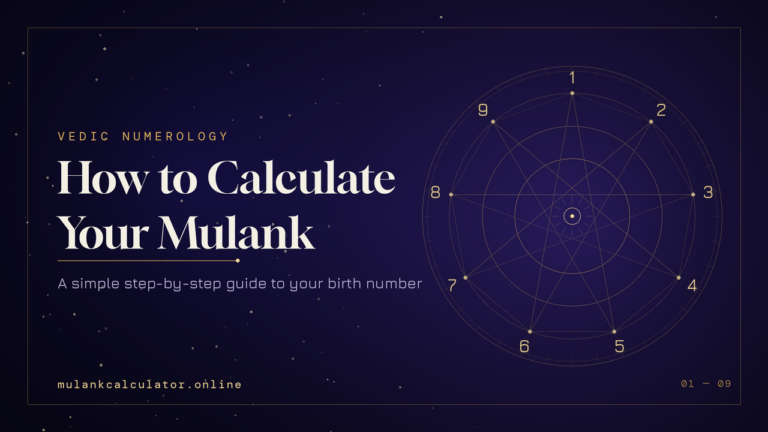
The simplest starting point in Ank Jyotish is your Mulank – and calculating it takes about ten seconds.
Take only the day of your birth. If it is a single digit, that is your Mulank. If it is two digits, add both digits together until you reach one digit between 1 and 9.
- Born on the 4th: Mulank is 4
- Born on the 19th: 1+9 = 10, then 1+0 = 1
- Born on the 27th: 2+7 = 9
Or skip the math entirely – use the free calculator at mulank calculator. Enter your date of birth, get your Mulank instantly, and download a detailed PDF report covering your ruling planet, personality traits, strengths, lucky color, lucky day, and compatible numbers – all in one place, completely free.
FAQs
Ank Jyotish aur numerology mein kya fark hai?
Numerology is the English word for the same system. Ank Jyotish specifically refers to the Indian Vedic tradition of numerology, which uses the Navagraha planetary framework and is connected to Jyotish Shastra. Western numerology uses the Pythagorean or Chaldean system without the same planetary integration. In everyday usage, most Indians use Ank Jyotish and numerology interchangeably.
Kya Ank Jyotish scientific hai?
No – Ank Jyotish is a traditional belief system, not a scientifically validated discipline. It is best approached as a tool for self-reflection and personal insight rather than a method for accurate prediction of external events.
Ank Jyotish se kya kya jaana ja sakta hai?
Your core personality (Mulank), your life path and long-term direction (Bhagyank), how others perceive you (Namank), your lucky colors, lucky days, compatible numbers, and the planetary energy governing your nature. For deeper readings, practitioners also look at personal year numbers, compatibility between two people’s numbers, and auspicious timing for major decisions.
Mulank aur Bhagyank mein se kaunsa zyada important hai?
Both serve different purposes. Mulank tells you about your core personality – the way you naturally are. Bhagyank tells you about your life direction – where life tends to lead you.
Kya Ank Jyotish se lucky color pata chal sakta hai?
Yes. Since each Mulank is ruled by a specific planet, and each planet has associated colors in the Vedic tradition, your Mulank gives you a clear set of lucky colors.
Kya Ank Jyotish sirf Hindus ke liye hai?
No. While Ank Jyotish has its roots in the Vedic tradition, it has been used by people across different faiths and communities in India for generations. The system works from your birth date, not from any religious belief, and can be used by anyone interested in self-understanding.
Summary
- Ank Jyotish (अंक ज्योतिष) means “number astrology” – the Indian Vedic tradition of numerology
- It is one of the oldest self-knowledge systems in India, connected to the same Navagraha planetary framework as Jyotish Shastra
- The three core numbers are Mulank (from birth day), Bhagyank (from full birth date), and Namank (from name)
- Every number from 1 to 9 is ruled by one of the nine Vedic planets – this planetary connection is what makes Vedic numerology unique
- The Indian system primarily uses the Chaldean method for name calculations, while Western numerology uses the Pythagorean method
- Ank Jyotish is best used as a tool for self-reflection – not as a scientific prediction system
- The simplest and most personal starting point is your Mulank – calculate yours free at mulank calculator